How to Choose the Right Cable Tray for Industrial and Commercial Electrical Installations
Choosing the right cable management system is an important part of planning any electrical installation. In industrial plants, commercial buildings, warehouses, data centers, and infrastructure projects, cables often need to travel across long distances while remaining properly supported and accessible. If cable routing is not planned correctly, maintenance can become difficult and future electrical modifications may require unnecessary work.
A cable tray provides a structured pathway for supporting and routing electrical cables. However, selecting one is not simply a matter of choosing a tray based on appearance or size. Different trays are designed for different loads, environments, cable types, and installation conditions.
Why Is Choosing the Right Cable Tray Important?
A cable tray becomes part of the overall cable management system. Its design can affect how easily cables are installed, inspected, maintained, and modified in the future. For industrial and commercial installations, the tray should be strong enough to support the expected cable load and suitable for the environment where it will be installed.
A suitable cable tray can help with:
- Keeping electrical cables properly organized
- Providing continuous support to cable runs
- Making maintenance and inspection easier
- Improving access around cables
- Making better use of available installation space
- Allowing room for future cable additions
- Reducing unnecessary cable routing problems
Start by Understanding the Cable Requirements
The first step in selecting a cable tray is to understand what cables it needs to carry. The tray should be selected according to the actual cable arrangement rather than choosing a standard size without checking the load.
Before selecting the tray, consider:
- Number of cables
- Cable diameter
- Total cable weight
- Cable type
- Required cable spacing
- Expected future cable additions
- Length of the cable route
For example, a tray carrying several heavy power cables will have different requirements from one used for lightweight communication cables. Understanding the cable load helps determine the required tray width, depth, strength, and support arrangement.
Select the Appropriate Cable Tray Type
Cable trays are available in several designs, and each design has practical uses. The choice should be based on the application and the type of cable being supported.
Ladder Cable Tray
Ladder cable trays have side rails connected by horizontal rungs. Their open design provides good ventilation and makes them suitable for many heavy-duty cable installations.
They are commonly considered for:
- Industrial plants
- Power distribution systems
- Large cable runs
- Manufacturing facilities
- Power generation projects
Perforated Cable Tray
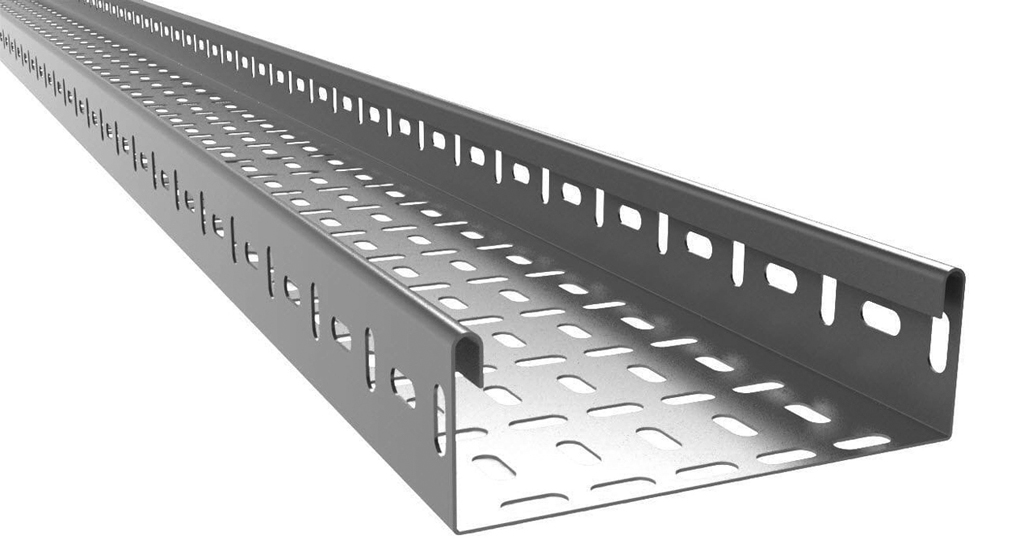
Perforated trays have openings along their base and sides. They provide cable support while allowing ventilation around the cable.
Solid Bottom Cable Tray
Solid bottom trays provide continuous support beneath the cables. They may be suitable where additional support or protection is required. Their continuous base can also help prevent small objects or debris from falling through the tray.
Wire Mesh Cable Tray
Wire mesh trays have a lightweight open structure and can be useful for communication, control, and smaller cable installations. Their construction also makes cable access relatively convenient. The open design can be useful where flexibility and ventilation are important.
Consider the Cable Tray Material
Material selection is another important factor. Cable trays can be manufactured using different materials, and the appropriate option depends largely on the operating environment.
Galvanized steel cable trays are commonly considered where strength and resistance to corrosion are required. They can be suitable for industrial and commercial installations.
Stainless steel can be selected for environments where stronger corrosion resistance is required. It may be useful in demanding industrial conditions and specialized applications.
Aluminum cable trays are lightweight and can provide good corrosion resistance. Their lower weight can also make handling and installation more convenient.
When choosing the material, consider:
- Indoor or outdoor installation
- Moisture exposure
- Chemical exposure
- Temperature conditions
- Required mechanical strength
- Expected service environment
- Maintenance requirements
Check the Required Cable Tray Size
Tray dimensions should be selected based on the cables that need to be installed. A tray that is too narrow may result in overcrowding, while an unnecessarily large tray can take up additional space and increase project costs.
Important dimensions include:
- Tray width
- Tray depth
- Side rail height
- Length of each tray section
- Available installation space
It is also important to consider bends, vertical sections, junctions, and other changes in cable direction. These areas may require suitable accessories and additional planning.
Calculate the Cable Load
Cable weight is one of the most important technical considerations when selecting a cable tray. The tray and its support system need to handle the expected load safely.
Load-related factors include:
- Total cable weight
- Number of cables
- Tray width and construction
- Support spacing
- Span between supports
- Additional future cable load
- Installation conditions
For industrial installations carrying large power cables, load calculations become particularly important. A tray should not be selected only by looking at its external dimensions.
Think About the Installation Environment
The environment in which a cable tray will be installed can significantly affect its selection. An indoor commercial building may have relatively controlled conditions, while an outdoor industrial installation may expose the tray to rain, humidity, dust, chemicals, and temperature changes.
Before selecting the tray, ask:
- Will it be installed indoors or outdoors?
- Is the area exposed to moisture?
- Are chemicals present nearby?
- Is the location dusty?
- Will the tray be exposed to high temperatures?
- Is there a possibility of mechanical impact?
- Does the environment require additional corrosion protection?
Understanding these conditions helps in selecting a suitable material and surface finish.
Keep Future Expansion in Mind
Electrical systems are often modified after the initial installation. A business may add new machinery, expand a production line, install additional equipment, or require new communication systems.
If the cable tray has no additional capacity, future modifications may require new cable routes or major changes to the existing installation. It is therefore useful to consider future requirements during the initial design.
Future planning may include:
- Leaving suitable tray capacity
- Allowing space for additional cables
- Planning spare routes
- Selecting accessible tray locations
- Providing suitable bends and expansion options
Check Cable Separation Requirements
Industrial and commercial installations can contain different types of cables. Power cables, control cables, instrumentation cables, and communication cables may have different installation requirements.
Depending on the project specifications, certain cables may need to be separated to reduce the possibility of electrical interference or other installation issues.
Proper cable separation can also make identification and maintenance easier because different cable groups remain organized.
Consider Installation and Maintenance Access
A cable tray should be positioned so that technicians can reach the cables when inspection or maintenance is required. Installing a tray in a difficult-to-access location may make even simple cable replacement more time-consuming.
During planning, consider:
- Accessibility
- Clearance around the tray
- Maintenance pathways
- Equipment locations
- Cable entry and exit points
- Future inspection requirements
Choose a Suitable Cable Tray Supplier
When comparing cable tray suppliers, businesses can consider:
- Product quality
- Material options
- Available sizes and designs
- Load requirements
- Surface finish
- Accessories
- Application suitability
- Technical guidance
- Delivery requirements
For businesses in Maharashtra, working with experienced Cable Tray Manufacturers in Pune can make it easier to discuss project requirements and select a suitable cable management solution.
Why Choose Mauli Techsol for Cable Tray Solutions?
Mauli Techsol provides cable tray solutions for electrical and industrial applications. The selection of a cable tray should always be based on the specific requirements of the installation.
For industrial and commercial projects, customers can evaluate cable tray options based on:
- Required tray type
- Material and finish
- Tray dimensions
- Cable load capacity
- Installation conditions
- Required accessories
- Future expansion requirements
Choosing a suitable cable tray solution at the planning stage can help create a more organized and accessible electrical installation.
Conclusion
Choosing the right cable tray requires more than selecting a product based on size or price. The tray should match the cables being carried, the installation environment, expected load, available space, and future requirements.
Industrial and commercial electrical installations can have very different requirements, so the same cable tray solution may not be suitable for every project. Careful planning helps ensure that the selected tray provides appropriate support while keeping cables organized and accessible.
For businesses looking for cable management solutions, consulting reliable Cable Tray Manufacturers in Pune can help identify products that match the technical and practical requirements of the project. A well-selected cable tray system can make installation more organized today and provide greater flexibility for maintenance and future electrical expansion.