How to Choose the Right FRP Cable Tray for Industrial and Electrical Applications
Selecting the right cable tray is an important part of planning a safe and organized electrical installation. In industrial plants, commercial buildings, power facilities, and other electrical projects, cables need proper support and protection. A suitable tray keeps cables organized, improves accessibility, and makes future maintenance easier.
FRP cable trays are widely used where corrosion resistance, electrical insulation, and long service life are important. However, not every FRP cable tray is suitable for every application. The tray size, load capacity, design, environment, and installation method should be considered before making a final choice.
Why Is Choosing the Right FRP Cable Tray Important?
A cable tray carries electrical and control cables over a planned route. If the tray is too small, weak, or unsuitable for the surrounding conditions, it can create problems during installation and operation. The correct FRP cable tray provides dependable support while keeping the cable arrangement neat.
Before selecting a tray, consider:
- Type and number of cables
- Cable weight and required load capacity
- Installation environment
- Tray dimensions
- Support spacing
- Temperature and fire conditions
- Future cable requirements
- Available accessories
Understand the Installation Environment
The surrounding environment is one of the first things to consider. Industrial locations may expose cable trays to moisture, chemicals, salt, dust, or corrosive gases. Conventional metal trays can require additional protection in such conditions.
FRP, or Fibre Reinforced Plastic, offers good resistance to corrosion and moisture. This makes it useful for chemical plants, water treatment facilities, coastal locations, manufacturing units, and other demanding environments.
When checking the environment, consider:
- Presence of chemicals or corrosive substances
- Indoor or outdoor installation
- Moisture and water exposure
- Dust and industrial pollutants
- Direct sunlight and weather conditions
Check the Type and Number of Cables
The cables being installed directly affect the tray selection. Power cables, control cables, instrumentation cables, and communication cables may have different sizes and weights.
First, prepare an approximate cable schedule. Note the number, diameter, and weight of the cables that will run through each tray section. This information helps determine the required tray width and depth.
It is also important to avoid overcrowding. Cables need enough space for proper arrangement, heat dissipation, inspection, and maintenance. A tray with adequate space makes installation more convenient and allows additional cables to be added later.
Select the Correct Tray Size
Tray dimensions should match the cable quantity and available installation space. A narrow tray may force cables into an overcrowded arrangement, while an unnecessarily large tray can increase material and installation costs.
Measure the available route and calculate the space required for the cables. Keep some additional capacity for future expansion rather than filling the tray completely from the beginning.
Consider:
- Tray width
- Tray depth
- Cable quantity
- Cable diameter
- Required clearance
- Space available for supports and fittings
Check the Load Capacity
Load capacity is another important factor. The selected tray should safely carry the combined weight of the cables, along with any other permitted load.
The required strength depends on cable weight, tray dimensions, support span, and installation arrangement. Longer support spans can increase the load placed on individual tray sections, so support spacing should be considered along with tray capacity.
Before purchasing, confirm the manufacturer's load information and recommended support spacing. This helps avoid excessive deflection and provides a stable cable management system.
Consider Electrical Insulation
FRP cable trays are non-conductive and offer electrical insulation. This characteristic can be useful in installations where electrical isolation is important.
Unlike conductive metal trays, FRP does not provide the same path for electrical current. However, the complete electrical system must still follow applicable safety and installation requirements. Cable bonding, grounding, separation, and other requirements should be evaluated according to the project.
FRP can therefore be considered for installations where insulation and corrosion resistance are both valuable.
Choose the Right Tray Design
FRP cable trays are available in different designs to suit different cable management requirements. The choice depends on the cable type, ventilation requirements, load, and installation conditions.
Common options include:
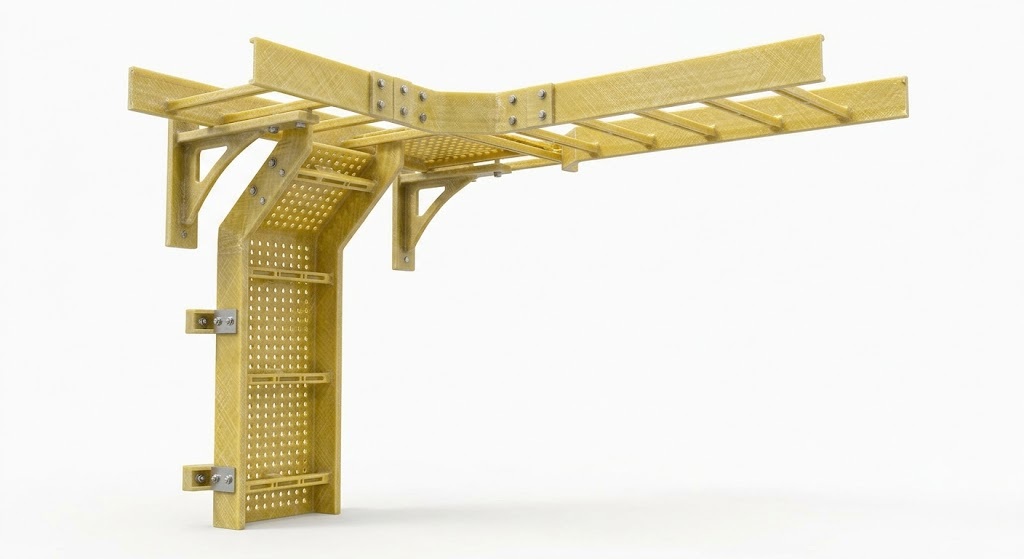
- Ladder-type trays for larger power cables and installations requiring good ventilation
- Perforated trays for general cable support and organized routing
- Solid-bottom designs where greater cable protection is required
- Customized designs for special industrial applications
A ladder design can provide convenient access and airflow, while a perforated design offers a practical balance between support and ventilation. The best option depends on the project's actual requirements rather than simply choosing the most common design.
Check Temperature and Fire Requirements
Industrial installations may experience high temperatures or specific fire-safety requirements. Therefore, the operating temperature and fire performance expected for the project should be checked before selecting the tray.
FRP products can be manufactured with different resin systems and performance characteristics. Ask the supplier for relevant technical information and confirm that the selected material is suitable for the expected operating conditions.
For projects with strict fire requirements, check the required fire-retardant properties and applicable project standards before finalizing the tray.
Plan the Support and Installation Arrangement
Even a strong tray needs proper installation. The support system should be planned according to the tray design, cable load, support span, and site conditions.
Supports should be positioned according to the manufacturer's recommendations. Poorly spaced supports may cause unnecessary bending or movement.
During installation, pay attention to:
- Horizontal and vertical alignment
- Support spacing
- Joints and connections
- Bends and changes in direction
- Clearance from other services
- Accessibility for maintenance
A well-planned support arrangement improves the stability and appearance of the complete cable management system.
Consider Future Expansion
Industrial electrical systems often change as production capacity increases or equipment is added. If the tray is selected only for the cables required today, there may be little room for future additions.
Leaving reasonable spare capacity can make later modifications easier. This does not mean selecting an unnecessarily oversized tray. Instead, estimate possible future cable requirements and choose dimensions that provide practical expansion space.
Planning for future needs can reduce the need for major cable route modifications later.
Choose a Reliable FRP Cable Tray Supplier
The quality of the tray is just as important as selecting the correct specifications. A reliable supplier should be able to provide information about material composition, dimensions, load capacity, resin properties, and installation recommendations.
When comparing FRP Cable Tray Manufacturers in Pune, check whether the supplier can understand your application instead of offering only standard products. Technical support can be useful when the project involves unusual cable loads, corrosive conditions, custom dimensions, or specific installation requirements.
Why Choose Mauli Techsol for FRP Cable Tray Requirements?
Mauli Techsol provides FRP cable tray solutions for industrial and electrical applications. The company focuses on practical cable management requirements and can help customers select suitable tray options according to project conditions.
When discussing your requirement, it is useful to share:
- Cable type and quantity
- Approximate cable weight
- Required tray width and depth
- Installation location
- Environmental conditions
- Support arrangement
- Future expansion requirements
Providing these details allows the supplier to understand the project more clearly and recommend an appropriate solution. Working with experienced FRP Cable Tray Manufacturers in Pune can also make planning, sizing, and installation more straightforward.
Conclusion
Choosing the right FRP cable tray requires more than selecting a tray based on size or appearance. Cable type, load, environment, insulation requirements, tray design, support spacing, temperature conditions, and future expansion should all be considered before placing an order.
FRP cable trays are a useful option for many industrial and electrical installations because they combine corrosion resistance, electrical insulation, and practical cable support. By understanding the site requirements and checking technical specifications carefully, you can select a tray that supports safe, organized, and efficient cable management.
A properly selected and installed FRP cable tray can also make maintenance easier and provide flexibility when the electrical system needs to expand.